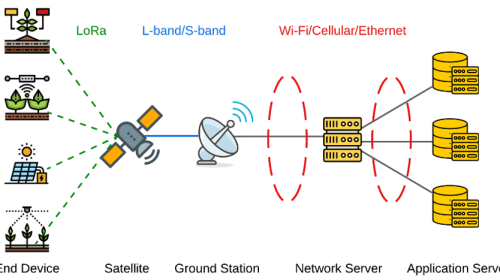
This line of research aims to study and optimise the new generation of networks based on the Internet of Things (IoT) and non-terrestrial networks, specifically satellite communications.
Specifically, work will be carried out with LPWAN (Low Power Wide Area networks) and the LoRaWAN network standard, whose main advantages are long range and low power consumption, but whose main problems are related to scalability (Aloha MAC protocol) and the limited adoption of Class B.
With regard to non-terrestrial networks, we are interested in studying LEO (Low Earth Orbit) Direct-to-Satellite IoT (DtS-IoT) satellite networks. DtS-IoT covers a wide range of applications and solutions in rural or rugged environments thanks to global satellite coverage. It allows end-devices to be deployed in places where infrastructure cannot be deployed.
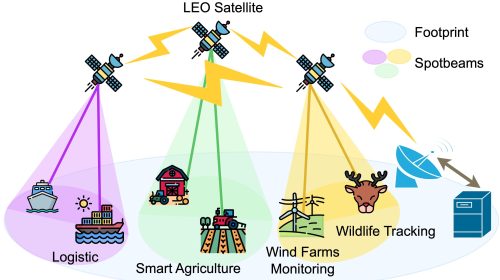
In particular, we are interested in integration with LoRaWAN to solve many problems related to lack of coverage in certain areas. They offer the advantage of global reach and the ability to manage a larger number of devices, but they present problems such as the need for synchronisation due to the limited pass window (satellite pass) and mobility.
The solutions are aimed at improving existing protocols and implementing new access control protocols and synchronisation techniques to determine the optimal transmission slots, as well as designing hardware and software in the MCU to manage low power consumption.